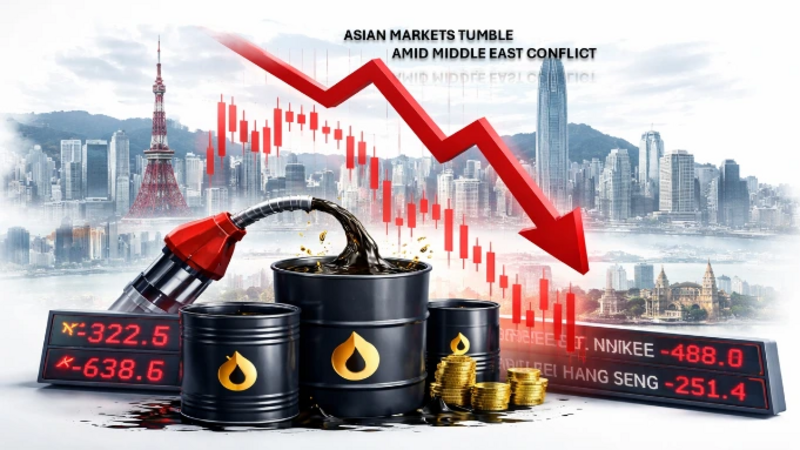
Asian stock markets, Asia market selloff, Middle East conflict impact, oil prices above $100, Nikkei 225 analysis, Nifty 50 decline, Hang Seng Index performance, Asia-Pacific market outlook, inflation and interest rates, global oil shock and markets. Image Credits: Kencrave
Asian Stock Markets Tumble As Middle East Conflict Sends Oil Above $100: Nikkei, Nifty, Hang Seng Weekly Market Analysis
Asian stock markets fell sharply in the week ending March 13, 2026, as escalating tensions in the Middle East triggered a surge in oil prices and renewed fears of persistent global inflation. The regional selloff hit major benchmarks across Japan, India, Hong Kong, China, and South Korea, with energy-importing economies experiencing the heaviest losses.
Rising crude prices, uncertainty surrounding shipping routes in the Strait of Hormuz, and shifting expectations for central bank policy drove investors toward safer assets. As a result, risk sentiment weakened across Asia-Pacific equities.
Asia Market Performance Summary
Most major Asian indices ended the week in negative territory as geopolitical tensions and macroeconomic concerns weighed heavily on investor sentiment.
Japan
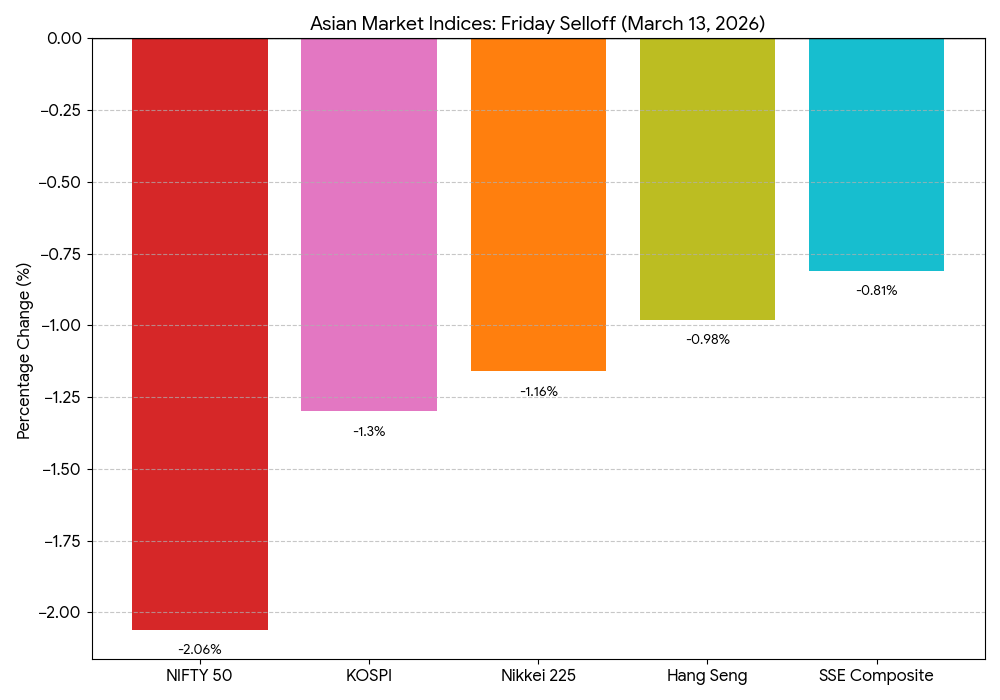
Japan’s benchmark Nikkei 225 declined 1.16% on Friday to close at 53,825 points, bringing its weekly loss to 3.24%. This marked the second consecutive week of declines for Japanese equities.
Major decliners included SoftBank Group (-4.3%), Advantest (-3.5%), and Honda Motor (-5.7%). Honda warned of potential annual losses related to electric vehicle restructuring costs and weak demand in China.
India
Indian markets experienced some of the steepest declines in Asia due to the country's heavy dependence on imported crude oil.
The Nifty 50 plunged 2.06% on Friday to 23,151.10, its lowest level in nearly 11 months. Meanwhile, the BSE Sensex dropped 1.93% on the final trading day, losing more than 1,470 points and ending the week down 5.5%.
Hong Kong
Hong Kong’s Hang Seng Index fell 0.98% on Friday to close at 25,465.60 as financial and technology stocks came under pressure.
Mainland China
China’s Shanghai Composite Index slipped 0.81% to end at 4,095.45. Mainland markets showed relative resilience earlier in the week compared to regional peers, though they eventually succumbed to broader risk-off sentiment.
South Korea
South Korea’s KOSPI declined 1.3% to close at 5,509.22 as technology stocks weakened amid rising global bond yields.
Major semiconductor companies including Samsung Electronics (-1.76%) and SK Hynix (-1.08%) weighed on the index following a volatile month for the chip sector.
Asia Market Data Snapshot
Asian stock market decline chart, NIFTY 50 leads losses, KOSPI, Nikkei, Hang Seng, SSE fall.
Key Drivers Behind the Asian Market Selloff
Middle East Conflict and Oil Price Surge
Escalating geopolitical tensions between the United States, Israel, and Iran intensified market volatility. Iran’s newly appointed Supreme Leader, Mojtaba Khamenei, vowed to keep the Strait of Hormuz closed, threatening one of the world’s most critical oil shipping routes.
The disruption could affect nearly 20% of global oil supply, pushing Brent Crude Oil above $100 per barrel despite emergency releases from the International Energy Agency.
Higher energy prices tend to weigh heavily on Asian economies that rely on imported oil, particularly India and Japan.
Inflation Concerns and Interest Rate Expectations
The surge in oil prices reignited fears that global inflation could remain stubbornly high throughout 2026.
Markets subsequently revised expectations for monetary easing from the Federal Reserve. Traders now anticipate only about 20 basis points of interest rate cuts for the remainder of the year, significantly lower than the 50 basis points priced in just a month earlier.
Higher interest rates generally reduce valuations for growth stocks and technology companies.
Currency Movements and Safe-Haven Demand
Risk aversion also drove strong demand for safe-haven assets.
The U.S. Dollar Index climbed above 100 as investors sought stability amid rising geopolitical risk.
Meanwhile, the Japanese yen weakened sharply, with USD/JPY rising above 159 and raising speculation that Japanese authorities could intervene in currency markets.
India’s rupee also came under pressure, falling to a record low of 92.45 against the U.S. dollar.
Sector Performance Across Asian Markets
The week saw sharp divergences across sectors as investors rotated capital toward energy producers and defensive assets.
Sectors Under Pressure
Financials
Banking stocks declined across several markets due to investor concerns about slower economic growth and foreign capital outflows.
Hong Kong financial stocks were particularly volatile after a major insider trading investigation involving multiple financial firms.
Indian banking stocks also weakened as foreign institutional investors withdrew over ₹7,000 crore in a single trading session.
Technology and Semiconductors
Technology shares across Asia declined as rising bond yields reduced the attractiveness of high-growth stocks.
South Korea’s semiconductor sector faced renewed selling pressure amid global uncertainty surrounding demand cycles.
Consumer and Automotive
Automotive stocks were among the hardest hit during the week.
Honda Motor shares dropped more than 6% after the company warned of its first annual loss in nearly seven decades due to costly electric vehicle restructuring efforts.
Higher fuel costs also hurt transportation companies across Southeast Asia, particularly in Indonesia.
Real Estate
Property developers continued to face headwinds from high interest rates, with real estate indices across several Asian markets falling between 2.7% and 3.3%.
Defensive and Outperforming Sectors
Energy
Energy companies were the standout performers during the week as oil prices surged.
China’s largest oil producers — CNOOC, PetroChina, and Sinopec — saw strong gains, with CNOOC rising as much as 10% in Shanghai trading.
In Malaysia, energy-linked firms such as Hibiscus Petroleum surged 18.5%, while Petronas Chemicals climbed 7%.
Basic Materials
Commodity exporters saw selective investor interest as rising global prices supported mining and infrastructure-related firms.
Indonesia’s Bumi Resources attracted foreign buying even as the broader market declined.
Outlook for Asian Stock Markets
Market volatility across Asia is likely to remain elevated in the coming weeks as investors closely monitor geopolitical developments in the Middle East and the trajectory of global oil prices.
If tensions around the Strait of Hormuz persist, sustained high energy prices could place additional pressure on inflation and delay central bank rate cuts.
Energy-importing economies such as India and Japan may remain particularly vulnerable to further oil price shocks, while energy producers and commodity exporters could continue to benefit from the current environment.
Key Takeaways
Escalating Middle East tensions triggered a sharp oil price surge and global market volatility.
Asian stock markets broadly declined, with India experiencing the largest losses.
Rising energy costs revived inflation concerns and reduced expectations for interest rate cuts.
Energy companies outperformed while financials, technology, and automotive stocks lagged.
FAQs
1. Why did Asian stock markets fall this week?
Asian stock markets declined due to escalating tensions in the Middle East that pushed global oil prices above $100 per barrel. The surge in energy costs raised concerns about persistent inflation and reduced expectations for interest rate cuts from the Federal Reserve. Major indices including the Nikkei 225, Nifty 50, and Hang Seng Index all recorded weekly losses as investors moved toward safer assets.
2. How do rising oil prices affect Asian stock markets?
Rising oil prices typically hurt Asian stock markets because many regional economies depend heavily on imported energy. Higher crude prices increase production costs, fuel inflation, and weaken currencies. During the latest market selloff, the surge in Brent Crude Oil particularly impacted energy-importing countries such as India and Japan, leading to significant declines in their equity markets.
3. Which sectors performed best and worst in Asian markets during the selloff?
Energy stocks were the top performers during the week as oil prices surged, benefiting major producers across China and Southeast Asia. In contrast, financials, technology, and automotive stocks faced heavy selling pressure. Semiconductor companies weighed on South Korea’s KOSPI, while banking stocks declined due to foreign investor outflows and concerns about slower economic growth.
Asian markets in April 2026 experienced significant volatility, driven by a sharp oil price shock linked to Middle East tension followed by a strong AI-led technology rally. The month began...
Asia Market Outlook Summary (Q1 2026)
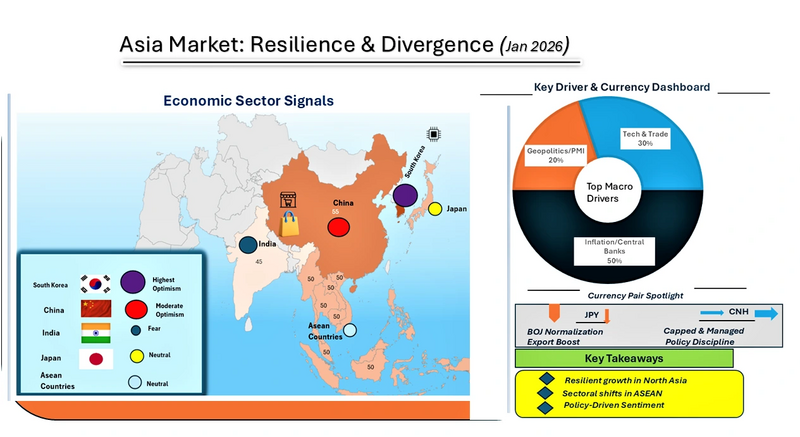
Asia Market Outlook 2026 points to a cautiously risk-on environment in early Q1, supported by easing inflation, resilient exports, and policy-managed stability across China,...