Smart city at sunset with North America AI network overlay, showcasing digital transformation, data connectivity, and urban innovation. Image Credits: Kencrave
Is Ai The Core Foundation Of Modern Business? A North American Analysis
Since its public introduction, artificial intelligence (AI) has evolved from a niche technology into a strategic growth driver for modern businesses. Its ability to analyze vast datasets, automate complex workflows, and generate predictive insights has reshaped how companies compete, innovate, and serve customers in the digital economy. This transformation has sparked intense AI adoption in business strategy, with organizations increasingly viewing AI as foundational to competitive advantage in areas such as innovation, supply chain optimization, and customer experience.
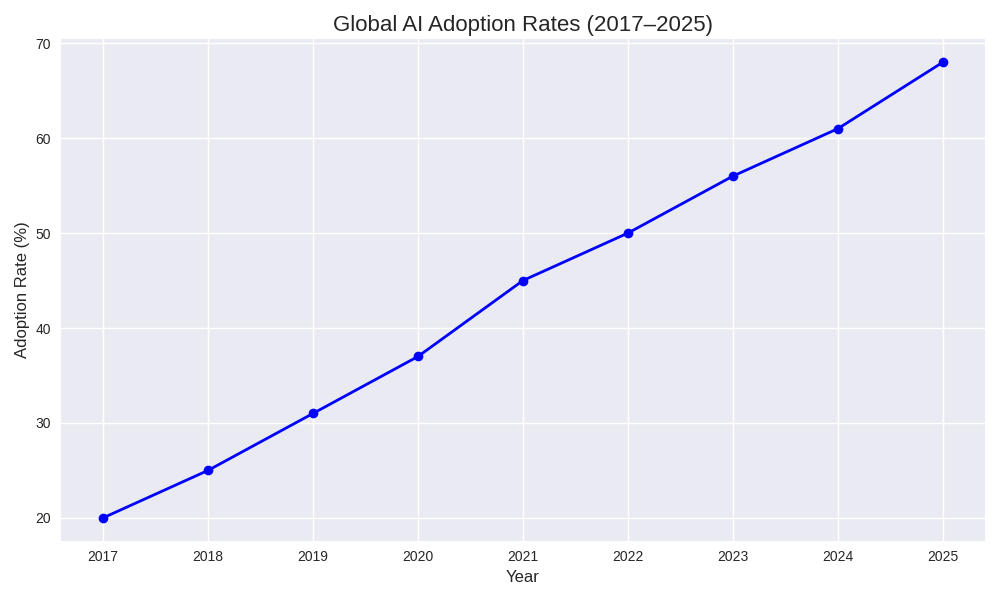
According to the McKinsey 2024 Global AI Survey, AI adoption surged globally to 72% of organizations reporting AI use in at least one business function, reflecting the rapid diffusion of AI across industries and business operations.
Global AI adoption rate 2017- 2025 line chart showing steady growth from 20% to 68% worldwide. Sources: McKinsey State of AI 2024, Statista, and Learn Hub | G2.
Key Insights from the chart
Early adoption (2017–2019): Mostly experimental, with AI used in niche applications.
Generative AI boom (2023–2025): Tools like ChatGPT and DALL·E pushed adoption rates sharply higher, especially in enterprise and consumer sectors.
AI Integration in Modern Business Development
Across sectors, companies are embedding AI‑driven automation, predictive analytics, and business intelligence tools into core processes such as data analytics, cybersecurity, customer service, and market forecasting. By leveraging machine learning models, natural language processing (NLP), and generative AI, firms can identify demand trends, personalize customer experiences, and optimize resource allocation with unprecedented speed and precision.
More than just improving operational efficiency, AI enables innovation pipelines that accelerate product development cycles and support cross‑functional strategic partnerships between tech developers, suppliers, and enterprise customers. As a result, AI is strengthening enterprise value chains and helping businesses unlock new revenue streams and market opportunities.
North American Case Studies of AI Adoption
In North America, AI adoption is particularly advanced and widespread:
Spotify’s AI DJ Feature: Spotify introduced its AI DJ in 2023 to craft personalized music streams based on individual listening behavior, enhancing user engagement and retention.
Figure AI and BMW Manufacturing: In 2024, BMW partnered with Figure AI to deploy AI‑powered humanoid robots in manufacturing lines to reduce worker fatigue and increase productivity, demonstrating practical applications of AI in industrial automation.
These cases illustrate how AI enhances both consumer‑facing services and industrial operational systems, showcasing the technology’s versatility in business transformation.
Why North America Has an Edge in AI Adoption
North America’s leadership in AI adoption stems from several distinct factors:
1. Strong Venture Capital Culture
The region benefits from robust venture capital (VC) ecosystems that fuel early‑stage funding for AI startups. Major investors are backing companies focused on enterprise AI tools, autonomous systems, and predictive analytics, which accelerates technology scaling and market penetration.
2. Top‑Tier Research Universities
Institutions like MIT, Stanford, and the University of Toronto produce cutting‑edge AI research, highly skilled graduates, and industry partnerships that feed into innovation pipelines across sectors.
3. Dense Tech Clusters
Tech hubs such as Silicon Valley, Boston–Cambridge, and Toronto‑Waterloo facilitate collaboration between startups, established enterprises, and research labs, accelerating AI commercialization and workforce development.
4. Regulatory Environment
While regulatory frameworks around data privacy and AI ethics continue to evolve, the relative flexibility of North American policy environments has enabled faster experimentation and adoption of emerging AI capabilities compared with more rigid regulatory regimes.
North America vs China AI adoption metrics: innovation drivers, funding, regulation, and commercialization speed
North America’s private‑sector‑driven model contrasts with China’s state‑led AI strategy, shaping different patterns of investment, deployment, and innovation across global markets.
AI Investment: North America vs Global Trends
Recent data from Statista indicate that North America maintained the highest regional AI adoption rate in 2023, reflecting strong enterprise investment and the integration of AI tools into business workflows. Additionally, regional AI investment analyses highlight that North America commanded a significant share of global AI funding in recent years, signaling sustained investor confidence in AI innovation and commercialization.
This concentration of AI investment reinforces the region’s role as a global AI hub, attracting talent, capital, and strategic partnerships that drive enterprise growth.
Risks, Regulation, and Ethical Considerations
Despite its strategic advantages, AI adoption introduces significant challenges, including data privacy concerns, model bias, workforce displacement, and ethical decision‑making frameworks. Organizations must navigate these risks while ensuring responsible AI governance, transparent data practices, and compliance with emerging regulatory frameworks like Canada’s Artificial Intelligence and Data Act.
Extended Implications for North American Businesses
AI’s influence goes beyond productivity and customer engagement to reshape core business dynamics:
1. Innovation Pipelines
AI accelerates R&D cycles and new product development by enabling faster hypothesis testing, automated prototyping, and data‑driven experimentation.
2. Supply Chain Optimization
AI‑driven predictive modeling enhances logistics planning, demand forecasting, and inventory management, reducing overhead and improving resilience in complex supply networks.
3. Strategic Partnerships
AI insights empower organizations to form data‑centric alliances with suppliers, technology partners, and channel distributors, strengthening ecosystem integration.
Key Takeaways: AI Adoption by Modern Businesses
AI is increasingly becoming a core foundation of business development across sectors.
North America leads in AI adoption due to strong venture capital ecosystems, talent pipelines, and tech clusters.
AI integration supports not just efficiency, but innovation, supply chain optimization, and strategic ecosystem partnerships.
Global comparisons show North America’s private‑sector‑led AI strategy contrasts with China’s state‑directed approach.
To maximize value, businesses must balance AI investment with ethical, regulatory, and risk management strategies.
Bottom Line
AI is no longer optional for modern enterprises; it is central to long‑term competitiveness, strategic innovation, and sustainable growth.
FAQs
1. Why is AI adoption critical for modern business development? AI enables data-driven decision-making, automation, innovation acceleration, and competitive advantage across operations, products, and customer experience.
2. How is artificial intelligence used in business today? Businesses use AI for predictive analytics, customer personalization, supply chain optimization, cybersecurity, automation, and generative AI applications.
3. Why does North America lead in AI adoption? North America benefits from strong venture capital ecosystems, top AI research universities, dense tech clusters, and faster commercialization of AI technologies.
4. How does AI improve supply chain and operational efficiency? AI enhances demand forecasting, inventory management, logistics optimization, and risk detection through real-time data analysis and predictive modeling.
5. How does North America’s AI strategy differ from China’s? North America relies on private-sector innovation and startups, while China emphasizes state-led AI initiatives and large-scale industrial deployment.
The United States is undergoing a supply chain realignment, driven by global disruptions, geopolitical tensions, and the need for greater systemic resilience. An era defined by cost-focused globalization and just-in-time...
Canada is entering a decisive decade. As global markets accelerate toward clean technologies, renewable energy, and climate-aligned investment, Canada’s green transition is emerging as both an economic necessity and a...

.png)