17 min read
Quantum Computing And Ai Supercomputing In Africa Focusing On Strategic Investments, Global Benchmarks, And Future Opportunities
Africa
Innovation
Africa is just beginning to explore quantum computing and AI supercomputing, with a real chance to skip old infrastructure and build directly on mobile platforms like M‑Pesa. But today, Africa invests only around $10 million per year in these technologies, while Asia, Europe, and North America spend billions. If this gap continues, Africa will depend heavily on foreign technology. This report recommends a $2-3 billion, five‑to‑seven‑year investment plan, along with stronger policies and partnerships, to help Africa improve healthcare, expand financial services, and build its own technology future.
Quantum computing and AI supercomputing are no longer futuristic concepts as they are reshaping finance, healthcare, and innovation ecosystems worldwide.
Quantum computing and AI supercomputing are no longer futuristic concepts as they are reshaping finance, healthcare, and innovation ecosystems worldwide.
Quantum computing: Early Years
Quantum computing emerged in the early 1980s as a theoretical concept proposed by Richard Feynman and David Deutsch, with practical algorithms like Shor's (1994) and Grover's (1996) marking its first breakthroughs. By the 2010s, major tech firms launched prototype processors, and in the 2020s commercialization began with billions invested globally.
Quantum computing emerged in the early 1980s as a theoretical concept proposed by Richard Feynman and David Deutsch, with practical algorithms like Shor's (1994) and Grover's (1996) marking its first breakthroughs. By the 2010s, major tech firms launched prototype processors, and in the 2020s commercialization began with billions invested globally.
Timeline of Quantum Computing Development
- 1981: Richard Feynman proposed that classical computers cannot efficiently simulate quantum systems, introducing quantum simulation idea in the computer industry.
- 1985: David Deutsch formulated the idea of a universal quantum computer, laying the path for programmable quantum machines.
- 1994: Peter Shor developed Shor's algorithm for factoring large integers, showing that quantum computers could break classical cryptography.
- 1995: Lov Grover came up with Grover's algorithm for database search, demonstrating exponential speedups in certain tasks.
- 1998: UC Berkeley built the first working 2‑qubit quantum computer.
- 2000s: Early experimental systems (5‑qubit NMR computers, ion trap experiments) proved feasibility.
- 2010s: IBM, Google, Microsoft, and startups like D‑Wave launched dedicated programs; prototype quantum processors became available on cloud platforms.
- 2019: Google claimed it had achieved quantum supremacy by performing calculation faster than classical supercomputers.
- 2020s: Commercialization accelerated, with billions in venture capital, sovereign wealth funds, and government R&D resulting in quantum piloting projects in finance, healthcare, and logistics.
Africa is slowly starting to position in quantum space, though the scale of investment and infrastructure remains modest compared to other geographical regions such as North America, Europe, and Asia. The continent's approach is consortium-driven and policy-led, with initiatives designed to leapfrog traditional barriers, while global peers are already monetizing breakthroughs at scale.
Quantum Computing & AI Supercomputing
a. Quantum Computing
Quantum computing uses the principles of quantum mechanics, such as superposition and entanglement, to process information in ways that classical computers cannot. Instead of bits (0 or 1), quantum computers use qubits, which can represent multiple states simultaneously. This allows them to solve certain complex problems (like optimization, cryptography, and molecular simulation) exponentially faster compared to traditional computers.
b. AI Supercomputing
b. AI Supercomputing
AI supercomputing is the use of high-performance computing (HPC) systems optimized for artificial intelligence workloads. These systems combine parallel processing, specialized hardware (like GPUs and TPUs), and advanced algorithms to train and run large-scale AI models. In practice, AI supercomputers enable breakthroughs in areas such as drug discovery, climate modeling, fraud detection, and natural language processing.
Quantum computing and AI supercomputing represent complementary technologies: quantum systems tackle problems that are intractable for classical computers, while AI supercomputers provide the scale and speed needed to deploy intelligent solutions across industries.
Africa's Emerging Quantum & AI Supercomputing Landscape
Africa's quantum and AI supercomputing ecosystem is still being formed in stages but shows promising signs of growth:
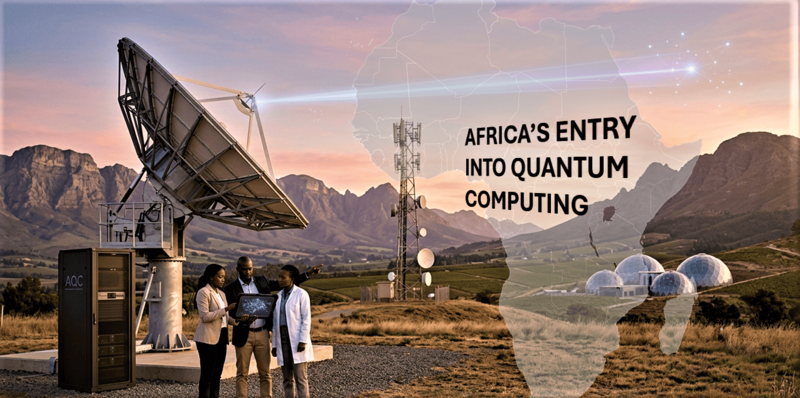
Africa Quantum Consortium (AQC): The Africa Quantum Consortium (AQC), established in the mid‑2020s, is a pan‑African initiative that unites universities, research centers, and governments to strengthen sovereign quantum capacity. It aims to nurture talent, build collaborative infrastructure, and drive applied research in sectors such as finance and healthcare.
Healthcare Applications: Since 2024-2025, South Africa, Rwanda and Kenya have been piloting several projects that integrate AI into public health systems. These initiatives focus on AI assisted clinical treatments.
Financial Sector Use Cases: Banks and fintechs in Nigeria and Kenya are experimenting with AI‑enhanced risk modeling and fraud detection. By leveraging mobile money ecosystems like M‑Pesa, which already serve millions, Africa has the opportunity to move beyond traditional banking infrastructure and employ next‑generation financial intelligence directly into platforms trusted by underserved populations.
Policy Support: These efforts are reinforced by strong policy backing. The African Union's Continental AI Strategy, introduced in 2024, prioritizes inclusive finance, healthcare, and climate resilience. By aligning with Agenda 2063, enabling AI adoption to support Africa's long‑term development goals while promoting technological sovereignty.
Healthcare Applications: Since 2024-2025, South Africa, Rwanda and Kenya have been piloting several projects that integrate AI into public health systems. These initiatives focus on AI assisted clinical treatments.
Financial Sector Use Cases: Banks and fintechs in Nigeria and Kenya are experimenting with AI‑enhanced risk modeling and fraud detection. By leveraging mobile money ecosystems like M‑Pesa, which already serve millions, Africa has the opportunity to move beyond traditional banking infrastructure and employ next‑generation financial intelligence directly into platforms trusted by underserved populations.
Policy Support: These efforts are reinforced by strong policy backing. The African Union's Continental AI Strategy, introduced in 2024, prioritizes inclusive finance, healthcare, and climate resilience. By aligning with Agenda 2063, enabling AI adoption to support Africa's long‑term development goals while promoting technological sovereignty.
Quantum Computing in African Healthcare
Africa's battle against infectious diseases and healthcare access gaps is pushing researchers and policymakers to explore unconventional tools, and quantum computing is quietly emerging as one of the most promising technologies that could redefine Africa's healthcare system.
By harnessing quantum algorithms, scientists can simulate how epidemics spread across populations with a level of complexity and speed that traditional computers simply cannot match, allowing health authorities to get ahead of outbreaks rather than merely responding to them.
South Africa is rapidly establishing itself at the forefront of global quantum innovation. In 2025 through a collaboration between South Africa's Stellenbosch University and China's University of Science and Technology created a record‑breaking 12,900‑kilometre quantum‑secure satellite link, the longest operational link of its kind anywhere in the world.
Using the Jinan‑1 microsatellite, the team successfully exchanged quantum encryption keys between the two countries, a first for the Southern Hemisphere. This achievement points to South Africa's growing scientific influence but also positions the country as Africa's pioneering leader in Quantum computing.
For quantum computing to be fully harnessed in Africa's public health systems it needs to be practical, affordable, and scalable enough to reach communities that have historically been left behind by medical innovation. The intersection of cutting-edge computing and African healthcare represents a real opportunity to reshape how the continent prepares for, and responds to, its most pressing health challenges.
Potential Case Benefits of Quantum Computing in Finance & Fintech
The banking sector stands to benefit enormously from quantum-powered risk modeling, which can process enormous volumes of financial variables simultaneously, something traditional computing simply cannot match at the same speed or accuracy. Rather than relying on outdated models that often miss early warning signs of financial instability, quantum systems can stress-test portfolios and forecast credit risks with far greater precision.
Beyond risk, the fight against financial fraud is also entering a new era, where AI systems running on supercomputing infrastructure can scan millions of transactions in real time, catching suspicious patterns before damage is done.
The leapfrogging opportunity: Much like how the continent skipped much of the landline infrastructure and jumped straight to mobile phones, platforms like M-Pesa represent a foundation that quantum-enhanced fintech could build on directly. The convergence of quantum computing and grassroots financial infrastructure could reshape what financial inclusion actually looks like across the continent.

Key Notes
- Skipped Landlines represents Africa's bypass of legacy infrastructure.
- Mobile Money (M‑Pesa) is identified as the foundation of digital financial inclusion in Africa.
- Quantum AI Fintech & Healthcare is the frontier of innovation and data‑driven growth which could be replicated across various ecosystems in Africa.
Global Quantum & AI Supercomputing Benchmarks (2026)
Global quantum computing and AI supercomputing investments reached record highs by 2026, with Asia, Europe and North America leading at multi‑billion levels. Europe anchored by its annual €1 billion flagship program, Asia backed by state‑funded billions, while South America and Australia are emerging players with smaller but growing commitments. Africa remains at an early stage.

While individual European nations like Germany, the UK, and France don't match the U.S. or China in total mission size, their combined annual spending (est $2.1B) makes them formidable in the Quantum race.
Australia and the United States are heavily influenced by defense sector Australia's position as a "Hardware Hub" is disproportionately large for its economy because of its role in AUKUS Pillar II, which focuses on quantum technologies for submarine detection and GPS-free navigation.
Countries like India, Brazil, and South Africa are focusing on a "Software First" niche. They are spending significantly less on building the actual quantum hardware and more on Quantum-Safe Cryptography and Algorithms. Their insight is that they don't need to own the hardware to benefit from the computation, provided they have the talent to code for it.
Global Investment Surge in Quantum Computing
In 2026, quantum computing investments have reached record highs, with SPAC (Special Purpose Acquisition Company) mergers, sovereign wealth fund commitments, and venture capital rounds driving commercialization. Institutional confidence signals long-term viability, with finance and healthcare leading adoption.

Key Observations
- The "Big Three": China, the US, and Japan remain the only nations in quantum computing investments spending over $1 Billion annually at the government level.
- Europe's Powerhouses: Germany and the UK have significantly increased their annual spending in 2026 to compete with US commercial giants, focusing on specific industrial use-cases.
- Mission Pacing: Note the difference between South Korea and the US. Korea has a large "Total Mission" ($2.3B) but a conservative annual spend, while the US spends nearly 60% of its authorized federal mission funds annually to maintain its hardware lead.
- Private Supplement: For the United States and Canada, these figures do not include an estimated $3.5B in annual private R&D from companies like Google, IBM, and Xanadu.
Comparative Regional Snapshot

1. Asia is the undisputed global leader in annual Quantum Investments
With $4.45B in estimated annual quantum budgets, Asia outpaces every other region by a wide margin. This signals is shaping this competitive frontier by:
With $4.45B in estimated annual quantum budgets, Asia outpaces every other region by a wide margin. This signals is shaping this competitive frontier by:
- Strong state‑driven investment (China, Japan, South Korea)
- Aggressive national quantum strategies
- A push for technological sovereignty
2. Europe and North America form the second tier
- Europe: $2.55B
- North America: $2.45B
They are nearly tied, forming a dual‑engine of Western quantum leadership. This reflects EU's coordinated quantum flagship program, U.S. and Canada's mix of government and private sector R&D, more diversified innovation ecosystem compared to Asia's centralized model.
3. The rest of the world is far behind
A steep drop-off occurs after the top three:
A steep drop-off occurs after the top three:
- Middle East: $550M
- Australia: $150M
- South America: $22M
- Africa: $10M
This highlights a global quantum divide, where emerging regions like Middle East, Australia, South America and Africa risk long‑term dependency on foreign quantum technologies.
Mission Fund Line: It shows extreme concentration. This means long term quantum investment is hyper‑concentrated in a few regions.
Quantum Investment Strategic Implications
- Quantum power and capabilities equate to geopolitical power: Regions leading in quantum will dominate: Cybersecurity, Advanced materials, AI acceleration, Cryptography and National defense.
- Emerging regions risk exclusion: Africa and South America's extremely low investment levels suggest:
Limited domestic quantum talent pipelines.
Dependence on foreign quantum infrastructure.
Vulnerability to future technological imbalances.
Dependence on foreign quantum infrastructure.
Vulnerability to future technological imbalances.
- Middle East an emerging Quantum power: With $550M, the region is investing more aggressively than Australia, South America, and Africa combined which is likely driven by: Sovereign wealth funds, National diversification strategies and Tech‑forward Gulf states.
Risks and Opportunities for Africa
Despite unique opportunities from Quantum adoption in Africa, Africa is constrained by several risks in Quantum computing adoption:
- Skills gap: The continent has a limited pool of quantum scientists, engineers, and AI specialists compared to global peers. Few universities currently offer advanced quantum curricula at the university level with only South Africa and Egypt doing so. The risk of brain drain remains high as talent migrates to better‑funded quantum computing labs outside Africa.
- Infrastructure limitations makes this issue more prevalent, with scarce high‑performance computing facilities, limited access to quantum hardware, and persistent power and connectivity challenges in some regions.
- Cybersecurity vulnerabilities also pose a serious threat. Quantum computing has the potential to break normal encryptions, and Africa lacks coordinated standards for quantum‑safe cryptography.
- Funding constraints further the slow progress, with investments still low compared to the multi‑billion commitments in North America, Europe, and Asia, leaving Africa to be dependent on foreign technology providers.
Despite these risks, Africa holds an opportunity to leapfrog traditional pathways by embedding quantum and AI directly into mobile‑first ecosystems such as M‑Pesa. If aligned with ESG goals, inclusive finance, and healthcare delivery, quantum adoption could accelerate financial inclusion and transform public health systems.
Regional collaborations like the Africa Quantum Consortium and policy frameworks such as the African Union's Continental AI Strategy provide a foundation for pooling resources and building sovereign capacity. By integrating into structured capital markets and forging global partnerships, Africa can mitigate risks while positioning itself as a future leader in quantum‑enabled innovations.
Strategic Policy & Investment Recommendations
African Union (AU) & Continental Policy Bodies
The African Union and its policy organs should spearhead a coordinated roadmap for quantum and AI adoption across the continent. A Pan‑African Quantum & AI Strategy running from 2026 to 2030 would set clear milestones for skills development, infrastructure expansion, and cybersecurity readiness.
This should include the rollout of quantum‑safe cryptography standards across financial and healthcare systems by 2028, alongside scholarship programs to train at least 500 specialists by 2030. Such initiatives would require an estimated $250-400 million over five years, a relatively modest investment compared to global peers, but one that could secure Africa's technological sovereignty if implemented with urgency.
International Development Finance Institutions (DFIs) & Impact Investors
DFIs and impact‑driven investors can play a catalytic role by funding regional quantum hubs in countries such as South Africa, Kenya, and Nigeria. These hubs should be equipped with high‑performance computing clusters and serve as centers for applied research in healthcare and fintech.
Public‑private partnerships could be structured to pilot epidemic modeling, drug discovery, and fraud detection projects, with financing tied to measurable ESG outcomes such as improved healthcare access or expanded financial inclusion. The estimated cost of building and scaling these hubs is between $1-1.5 billion over a 5-7 year horizon and full operational capacity achieved by 2030.
Big Tech & Quantum Cloud Providers
Global technology companies and quantum cloud providers have an opportunity to accelerate Africa's readiness by offering access credits to universities and startups, enabling them to experiment with quantum algorithms without prohibitive infrastructure costs. Joint research labs established with African institutions could co‑develop solutions tailored to local needs, particularly in healthcare and finance.
At the same time, these firms could provide cybersecurity toolkits to prepare governments and businesses for the transition to quantum‑safe encryption. The estimated investment for such initiatives is $500-700 million over five years, with pilot programs beginning in 2026-2027 and scaled partnerships by 2028, leading to commercial integration by 2030.
At the same time, these firms could provide cybersecurity toolkits to prepare governments and businesses for the transition to quantum‑safe encryption. The estimated investment for such initiatives is $500-700 million over five years, with pilot programs beginning in 2026-2027 and scaled partnerships by 2028, leading to commercial integration by 2030.
Overall Outlook
Africa requires an investment of roughly $2-3 billion over the next 5-7 years to position itself as a credible player in the global quantum race. By combining policy leadership from the AU, accelerated financing from DFIs and impact investors, and technical partnerships with Big Tech, Africa can mitigate capital, policy and infrastructural risks. It can forge ahead by leapfrogging traditional pathways and embed quantum innovation into mobile‑first ecosystems.
Africa's Quest for Quantum Computing & AI Supercomputing
Africa's dream of quantum computing and AI supercomputing is more than a technological ambition; it is a strategic pathway to secure sovereignty, leapfrog traditional barriers, and foster inclusive growth. While the continent faces risks in skills, infrastructure, and cybersecurity, the alignment of policy, investment, and partnerships offers a roadmap to transform healthcare, finance, and inclusive growth. With decisive action, Africa can position itself not as a follower but as a future leader in the global quantum race.
Strategic implications for decision‑makers
Governments
Quantum must be treated as a core strategic capability, not a niche research field.
Late movers risk locking into foreign policy and infrastructure.
Quantum must be treated as a core strategic capability, not a niche research field.
Late movers risk locking into foreign policy and infrastructure.
Corporates & financial institutions
Early partnerships with Tier 1 and Tier 2 ecosystems can create durable competitive advantage.
Risk models, encryption strategies, and data architectures must be future‑proofed for quantum.
Early partnerships with Tier 1 and Tier 2 ecosystems can create durable competitive advantage.
Risk models, encryption strategies, and data architectures must be future‑proofed for quantum.
Investors
Quantum is less about isolated startups and about securing a stake in the continent’s emerging technology ecosystem. Whoever shapes the infrastructure, talent pipeline, and encryption standards will control the future stack. Moving early into regional quantum hubs and sovereign talent partnerships can lock in durable competitive advantage
Quantum is less about isolated startups and about securing a stake in the continent’s emerging technology ecosystem. Whoever shapes the infrastructure, talent pipeline, and encryption standards will control the future stack. Moving early into regional quantum hubs and sovereign talent partnerships can lock in durable competitive advantage
What to watch for the next 3 - 5 years (2026 - 2030)
- Post‑quantum cryptography mandates from major regulators.
- Quantum alliances or blocs (e.g., NATO‑aligned, BRICS‑aligned quantum initiatives).
- Sovereign wealth-backed quantum hubs in the Middle East and Asia.
- Talent flows from Global South to Tier 1 hubs, deepening capability gaps.
Frequently Asked Questions (FAQs): Quantum Computing in Africa
1. What is quantum computing and why does it matter for Africa?
Quantum computing uses quantum mechanics to process complex data exponentially faster than traditional computers. For Africa, it offers transformative potential in healthcare, financial inclusion, and climate modeling, sectors which are critical to the continent's development agenda.
Quantum computing uses quantum mechanics to process complex data exponentially faster than traditional computers. For Africa, it offers transformative potential in healthcare, financial inclusion, and climate modeling, sectors which are critical to the continent's development agenda.
2. How is Africa investing in quantum computing and AI supercomputing?
Africa's investment is primarily consortium-driven and policy-led, anchored by the Africa Quantum Consortium (AQC) and the African Union's Continental AI Strategy (2024). Key initiatives are focused on talent development, collaborative infrastructure, and applied quantum research.
Africa's investment is primarily consortium-driven and policy-led, anchored by the Africa Quantum Consortium (AQC) and the African Union's Continental AI Strategy (2024). Key initiatives are focused on talent development, collaborative infrastructure, and applied quantum research.
3. How does Africa's quantum investment compare to global leaders?
Africa remains at an early stage compared to Asia state funding and North America's multi-billion-dollar VC and federal funding, the EU's €1 billion Quantum Flagship. However, Africa's leapfrogging potential through mobile-first ecosystems presents a unique pathway to rapid advancement.
Africa remains at an early stage compared to Asia state funding and North America's multi-billion-dollar VC and federal funding, the EU's €1 billion Quantum Flagship. However, Africa's leapfrogging potential through mobile-first ecosystems presents a unique pathway to rapid advancement.
4. What are the biggest challenges and opportunities for quantum computing in Africa?
The primary challenges include limited infrastructure, underfunding, and the risk of dependency on foreign technology. Key opportunities lie in integrating quantum AI into mobile ecosystems, aligning with ESG goals, and leveraging regional collaboration to attract sovereign and institutional investment.
The primary challenges include limited infrastructure, underfunding, and the risk of dependency on foreign technology. Key opportunities lie in integrating quantum AI into mobile ecosystems, aligning with ESG goals, and leveraging regional collaboration to attract sovereign and institutional investment.

Senior Editor: Kenneth Njoroge
Business & Financial Expert | MBA | Bsc. Commerce | CPA
Author Name
Author intro
Author bio goes here.