Three pillars of UN Resolution A/80/L.48 demanding formal apologies from member states, return of looted African artifacts, and establishment of reparations fund for descendants of enslaved people.
Africa
On March 25, 2026, the UN General Assembly adopted Resolution A/80/L.48, introduced by Ghana, marking a historic moment in the global reckoning with slavery. The resolution formally recognizes the transatlantic trafficking of enslaved Africans and racialized chattel enslavement as the gravest crime against humanity, describing it as a 400‑year injustice that displaced an estimated 13 million Africans.
Timed to coincide with the International Day of Remembrance of the Victims of Slavery and the Transatlantic Slave Trade, the resolution carries significant symbolic weight. Importantly, it goes beyond condemnation by demanding three concrete actions: formal apologies from member states, the restitution of looted African artifacts and archival materials held in Western institutions, and the creation of a reparations fund for descendants of enslaved people.
Yet, despite this milestone, the UN has historically struggled to address slavery’s legacy in practice. Modern forms of slavery, such as human trafficking, forced labor, and child exploitation, persist worldwide, underscoring the gap between moral declarations and enforceable action. This tension reflects the UN’s limited enforcement powers, the reluctance of powerful states to assume legal or financial liability, and the difficulty of translating historical accountability into present‑day justice.
Timed to coincide with the International Day of Remembrance of the Victims of Slavery and the Transatlantic Slave Trade, the resolution carries significant symbolic weight. Importantly, it goes beyond condemnation by demanding three concrete actions: formal apologies from member states, the restitution of looted African artifacts and archival materials held in Western institutions, and the creation of a reparations fund for descendants of enslaved people.
Yet, despite this milestone, the UN has historically struggled to address slavery’s legacy in practice. Modern forms of slavery, such as human trafficking, forced labor, and child exploitation, persist worldwide, underscoring the gap between moral declarations and enforceable action. This tension reflects the UN’s limited enforcement powers, the reluctance of powerful states to assume legal or financial liability, and the difficulty of translating historical accountability into present‑day justice.

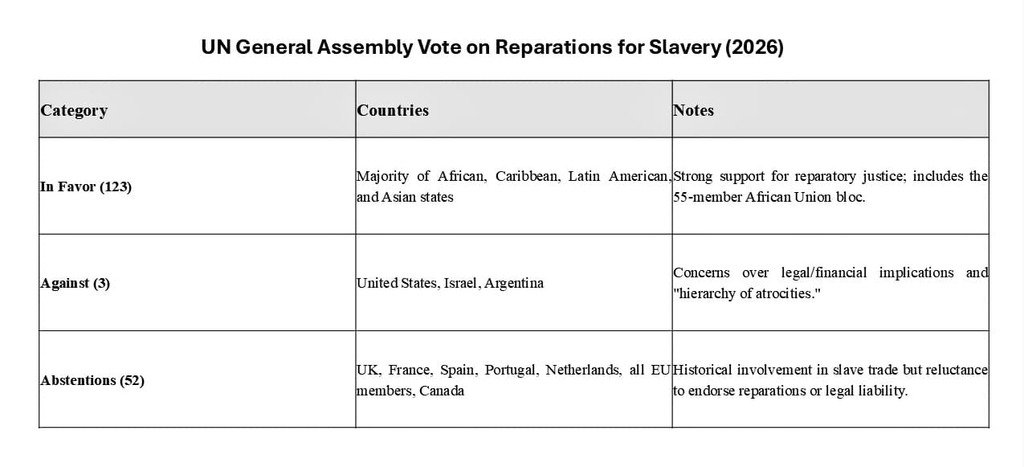
What Does the 2026 UN Slavery Reparations Resolution Require?
The resolution is based on 3 pillars. It demands:
- Apologies: A full and formal apology from member states for their role in the slave trade.
- Restitution: The return of cultural property, artifacts, and archives looted during the colonial era.
- Repair: Contributions to a reparations fund to address persistent inequalities.
African Leadership & The "Justice vs. Money" Debate
- Oliver Barker-Vormawor (legal practitioner) noted that the resolution "underemphasizes" direct compensation because "the transatlantic slave trade was about the monetization of human lives. We cannot lead the global conversation with a monetized conversation."
- Instead, priorities include educational funds, skills training, and research into slavery's impact on global relations.
The U.S. Opposition: Legal and Temporal Arguments
The United States (joined by Israel and Argentina) provided a legal defense for its "No" vote:
- Non-Retroactivity: Argues that acts legal in the 15th-19th centuries (slavery was regulated by law then) cannot be judged by modern jus cogens (peremptory norms).
- "Cynical Usage": Accused the resolution of trying to "reallocate modern resources to people and nations who are distantly related to the historical victims."
- "Hierarchy of Atrocities": The U.S. objected to ranking the slave trade as the gravest crime, arguing this diminishes the suffering of victims of the Holocaust, genocide, and other atrocities.
The Western Abstentions
While the U.S. voted no, European powers (UK, France, Spain) abstained.
- The UK Position: Has historically refused reparations, arguing current institutions cannot be held liable for past wrongs. Notably, the UK spent over $21 billion (in today's money) in the 1830s compensating slave owners for their "loss of property" when slavery was abolished, but has paid nothing to descendants of the enslaved.

- Legal Reluctance: European states fear that a formal apology could be used in international courts as an admission of legal liability for trillions in damages.
European Alternatives: Heritage Partnerships and Restitution Agreements
While many European states abstained from the vote, some have begun testing alternative approaches that stop short of formal reparations. France has pursued heritage partnerships, such as its collaboration with Benin, which facilitated the return of 26 royal artifacts in 2021 and established cultural exchange programs rather than financial compensation.
Germany has entered into restitution agreements with Nigeria, committing to return hundreds of Benin Bronzes while supporting joint museum projects and research initiatives. These models reflect a preference for cultural diplomacy and shared heritage management, allowing European governments to acknowledge historical wrongs without creating direct legal liability for reparations.
Germany has entered into restitution agreements with Nigeria, committing to return hundreds of Benin Bronzes while supporting joint museum projects and research initiatives. These models reflect a preference for cultural diplomacy and shared heritage management, allowing European governments to acknowledge historical wrongs without creating direct legal liability for reparations.
How Much Could Slavery Reparations Cost?

The vote acknowledges slavery’s enduring socio-economic consequences.
- The Price Tag: CARICOM (Caribbean nations) estimates former colonial powers owe at least $33 trillion in reparations. The Robison Report calculated a potential figure of $107 trillion owed by 31 countries.

- The Precedent: Unlike Germany’s $80 billion payment to Holocaust survivors (Jews,Roma,people with disabilities and others who underwent discrimination between 1933 and 1945), no country has ever paid reparations for slavery due to the "passage of time" and difficulty identifying direct beneficiaries.
ASEAN Division
The vote exposed fractures beyond the West. While most Asian states supported it, Cambodia's abstention was notable. Analysts suggest that given Cambodia’s own history with the Khmer Rouge (genocide), its refusal to endorse a "gravest crime" label highlights a diplomatic fear of creating hierarchies of atrocity that could complicate international law regarding human trafficking.
How This Compares to Previous UN Actions on Slavery
- 1948: Universal Declaration of Human Rights prohibits slavery.
- 1956: Supplementary Convention on the Abolition of Slavery.
- 2001: Durban Declaration acknowledges slavery as a crime against humanity.
- 2015: UN International Decade for People of African Descent launched.
- 2026: Ghana-led resolution declares trans-atlantic slave trade the gravest crime against humanity, and demands artifacts return and reparations fund.
Strategic Policy Recommendations
For African Governments
Leverage the resolution’s moral authority to press for the return of specific artifacts such as the Benin Bronzes, currently held in British museums. Legal channels through UNESCO conventions can strengthen these demands.
For European States
Move beyond vague “statements of regret” and issue formal apologies, following the example of the Netherlands in 2022.Instead of direct cash reparations, establish social development funds that support education, healthcare, and cultural preservation in affected communities.
Move beyond vague “statements of regret” and issue formal apologies, following the example of the Netherlands in 2022.Instead of direct cash reparations, establish social development funds that support education, healthcare, and cultural preservation in affected communities.
For the United States
The government should confront its domestic inconsistency: reparations were paid to Japanese‑American internees in 1988 and Holocaust survivors, yet the legacy of chattel slavery remains unaddressed. Acknowledging this gap would strengthen U.S. credibility in global human rights discourse.
For Civil Society
Education must be prioritized. Many citizens in Western nations remain unaware that Britain and the U.S. only finished repaying the loans used to compensate slave owners in the 21st century. Civil society organizations can use this fact to spark dialogue, raise awareness, and build pressure for more meaningful action.
Bottom Line
The 2026 UN slavery reparations resolution marks a turning point in global discourse, shifting from symbolic recognition to structured demands. However, its real-world impact will depend on political will, legal developments, and sustained international pressure.
Education must be prioritized. Many citizens in Western nations remain unaware that Britain and the U.S. only finished repaying the loans used to compensate slave owners in the 21st century. Civil society organizations can use this fact to spark dialogue, raise awareness, and build pressure for more meaningful action.
Bottom Line
The 2026 UN slavery reparations resolution marks a turning point in global discourse, shifting from symbolic recognition to structured demands. However, its real-world impact will depend on political will, legal developments, and sustained international pressure.
Key Takeaways
- Historic but Non-Binding: It creates a moral precedent but does not force payments.
-
Artifacts are the Front Line: The most actionable part of the resolution is the demand for returning looted cultural heritage.
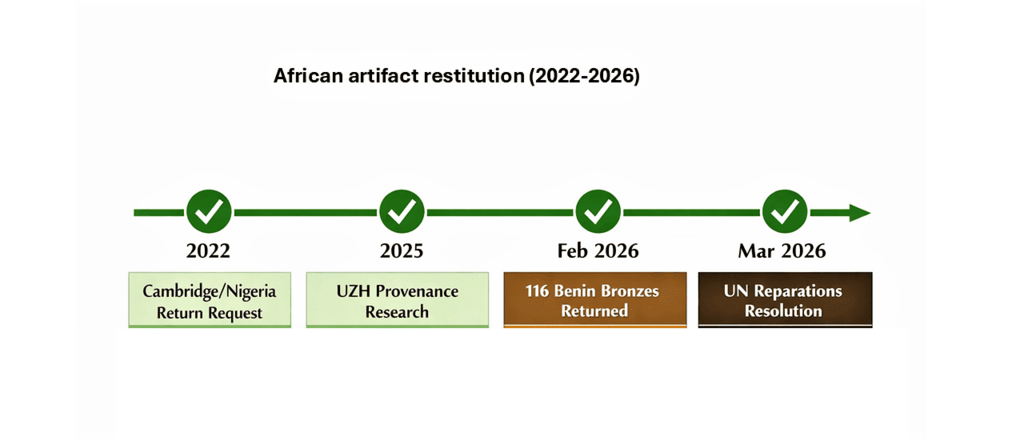
Timeline 2022 to 2026 showing momentum toward African artifact restitution culminating in 116 Benin Bronzes returned and UN resolution demanding looted cultural property. - Exposed Fractures: The vote revealed a firm Global South vs. Global North divide on whether historical wrongs require modern financial repair.
FAQs
1. Why is this resolution historic?
It is the first time the UN explicitly linked the slave trade to a demand for return of artifacts and a reparations fund, not just words.
2. Which countries opposed it?
The United States, Israel, and Argentina.
3. Why did European nations abstain?
Fear that apologizing or voting yes would expose them to trillion-dollar lawsuits in international courts, similar to how Germany was sued for WWII crimes.
4. Does the resolution have legal force?
No. However, the demand for "restitution of cultural property" aligns with existing UNESCO conventions, giving it stronger legal weight than the reparations calls.
5. What happens next?
The UN Secretary-General must produce a report on implementation by the 82nd GA session (2027). Expect legal battles in the ICJ regarding artifact ownership.