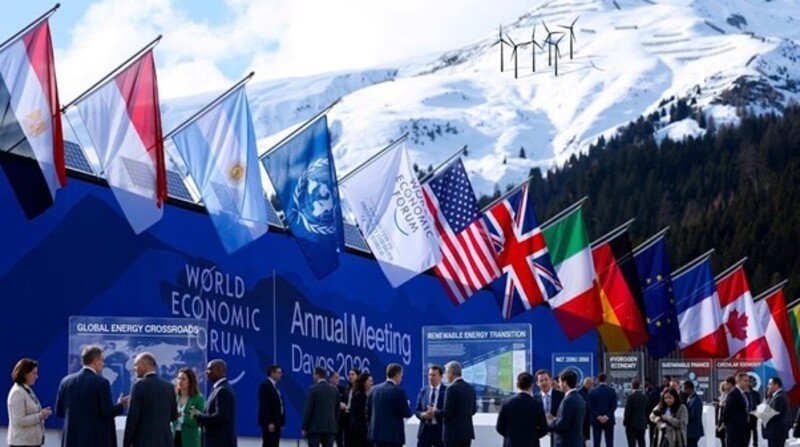
The World Economic Forum (WEF) Annual Meeting 2026 in Davos, Switzerland (January 19-23) convened nearly 3,000 leaders under the theme “A Spirit of Dialogue.” The meeting reflected a convergence of geopolitical, economic, and environmental priorities, with direct implications for Africa and Kenya in climate finance, refugee integration, and positioning Nairobi as a financial hub.
Keynote Speakers and Highlights at Davos 2026
President Donald Trump (United States): Stressed the importance of energy security and warned against overdependence on rare-earths from single regions, calling for “balanced supply chains that protect national sovereignty.”
Ursula von der Leyen (European Commission President): Urged accelerated climate finance pledges, noting that “Africa’s renewable energy potential is not just regional; it is central to Europe’s net-zero future.”
President William Ruto (Kenya): Presented the Shirika Plan as a model for refugee integration, stating that “refugees must be seen as contributors to resilience, not burdens,” while positioning Nairobi as a rising financial hub.
President Cyril Ramaphosa (South Africa): Highlighted South Africa’s BRICS role and green hydrogen investments, emphasizing that “Africa must shape the rules of sustainable finance, not just follow them.”
President Bola Tinubu (Nigeria): Spoke on Nigeria’s energy markets, balancing oil exports with renewable diversification, declaring that “Africa’s energy future must be both profitable and sustainable.”
President Abdel Fattah el-Sisi (Egypt) and King Mohammed VI (Morocco): Showcased North Africa’s solar and wind projects as critical to Europe’s energy transition, with el-Sisi noting “the Sahara sun can power continents,” and King Mohammed VI adding that “Morocco’s wind corridors are bridges to shared prosperity.”
Historical Context of Davos
Since its founding in 1971, WEF has evolved from a European management symposium into the world’s premier platform for global cooperation. Over the decades, it has addressed Cold War tensions, globalization, and digital transformation. In 2026, Davos reaffirmed its role as a neutral convening space amid geopolitical fragmentation, echoing its legacy of bridging divides.
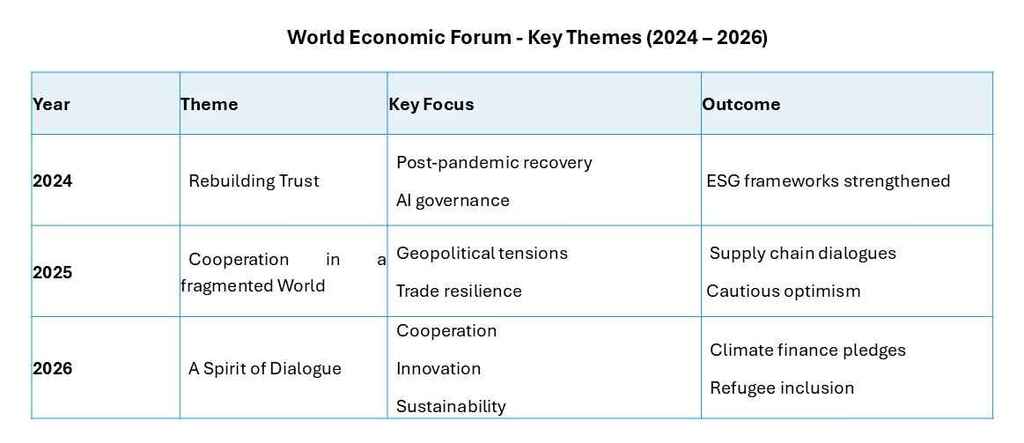
World Economic Forum 2024–2026 key themes table highlighting global priorities in trust, cooperation, innovation, sustainability, and climate finance outcomes.
Davos themes evolved from rebuilding trust in 2024, to managing fragmentation in 2025, and finally to dialogue and Africa’s strategic role in 2026.
Comparative Analysis: WEF Davos 2025 vs. WEF Davos 2026
Tone Shift: WEF DAVOS 2025 emphasized “fragmentation” and the risks of geopolitical breakdown while the WEF DAVOS 2026 pivoted to “dialogue,” signaling cautious optimism and renewed multilateralism.
Economic Focus: WEF DAVOS 2025 prioritized trade resilience and supply chain security while the WEF DAVOS 2026 shifted toward green growth and inclusive finance, spotlighting Africa’s renewable energy potential.
Security Lens: WEF DAVOS 2025 centered on geopolitical conflict management while WEF DAVOS2026 broadened security to include climate resilience and refugee stability, aligning with Kenya’s Shirika Plan.
ESG Evolution: WEF DAVOS 2025 ESG debates were corporate-driven while the WEF DAVOS 2026 ESG expanded to national policies, refugee inclusion, and indigenous rights, making Africa’s adaptation financing gap a global priority.
Key Insight: Davos 2026 marked a transition from defensive postures to proactive collaboration. Implication: Kenya and Africa gained visibility as strategic partners rather than peripheral actors.
Security Risks and Strategic Importance
Davos 2026 highlighted geopolitical risks:
NATO cohesion amid conflicts in Eastern Europe.
Cybersecurity threats from AI misuse.
Africa’s role in peacekeeping and refugee integration.
Economic Coercion and Resource Competition
Economic discussions focused on:
Green energy transitions and rare-earth supply chains.
Africa’s potential as a renewable energy hub.
Nairobi’s push to become a regional financial center via the Nairobi International Financial Centre (NIFC).
Geopolitical Coercion and International Relations
Davos underscored fractures in multilateralism, with U.S., EU, and China competing for influence. African leaders emphasized equitable access to climate finance and warned against neo-colonial resource extraction.
Kenya showcased its Shirika Plan for refugee integration as a model of resilience.
Kenya's Shirika Plan emerged as a flagship initiative at Davos 2026, embodying the forum's call for inclusive resilience. The plan transforms the long-standing refugee camps of Dadaab and Kakuma, home to over 500,000 refugees, into integrated settlements with municipal status. This grants refugees access to public services, land rights, and economic opportunities, while fostering social cohesion with host communities.
By aligning with the Global Compact on Refugees and the Comprehensive Refugee Response Framework, the Shirika Plan positions refugee integration as a development opportunity rather than a humanitarian burden. Davos leaders recognized this approach as a scalable model for other refugee-hosting nations, linking it directly to ESG goals, climate adaptation, and sustainable finance.
Key Insight: Africa is reframing itself as a partner, not a recipient, in global governance. Implication: Wef 2026Davos outcomes could shift Africa’s bargaining power in multilateral forums.
Environmental and ESG Considerations
Climate change dominated World Economic Forum in Davos 2026, with pledges to accelerate net-zero transitions.
Greenland’s ice melt was cited as a global warning, but Africa’s adaptation financing gap was spotlighted.
Indigenous rights and refugee inclusion were linked to ESG frameworks.
Key Insight: ESG debates now extend beyond corporations to national policies and refugee integration. Implication: Kenya’s refugee inclusion strategy positions it as a leader in ESG-aligned governance.
WEF Risk Assessment 2026
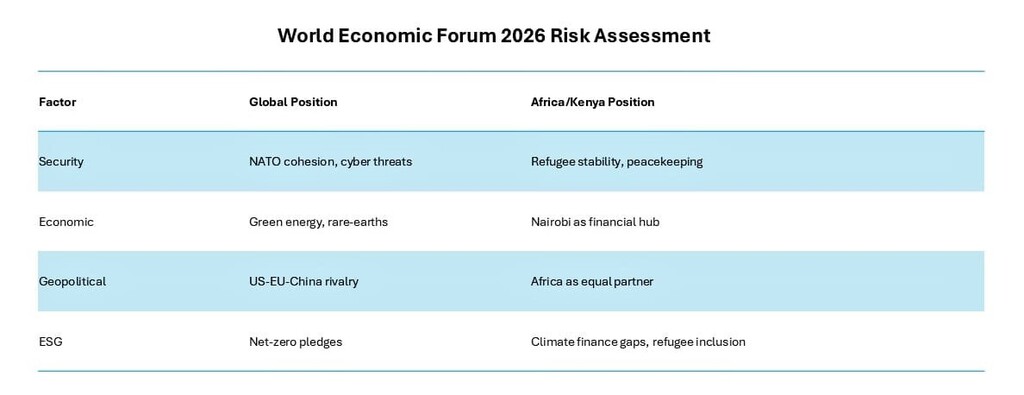
World Economic Forum 2026 Risk Assessment table comparing global vs Africa/Kenya positions on security, economy, geopolitics, and ESG sustainability challenges.
Davos 2026 positioned Africa at the center of global risk mitigation, linking security, economic, geopolitical, and ESG challenges to highimpact outcomes.
WEF 2026 Global Consequences
WEF Davos 2026 outcomes will ripple across continents:
Energy markets: Africa’s renewable energy potential could reshape supply chains.
Climate finance: Equitable funding is critical to prevent instability in vulnerable regions.
Refugee governance: Kenya’s Shirika Plan may become a global model.
Financial hubs: Nairobi’s positioning could attract fintech and ESG capital.
KeyInsight: WEF Davos 2026 reframed Africa from a peripheral actor to a strategic partner in global resilience. Implication: Kenya’s leadership in finance, climate, and refugee integration could redefine its global role.
Strategic Recommendations for Key Stakeholders
Kenyan Government
Strengthen NIFC governance for ESG capital.
Scale Shirika Plan globally.
Expand geothermal, wind, and solar projects.
Position Nairobi as fintech hub.
Secure bilateral climate finance deals.
African Governments
Coordinate renewable energy projects.
Push for equitable climate finance.
Guard against neo-colonial extraction.
Integrate refugee inclusion into development.
Build green hydrogen & rare-earth alliances.
Investors
Prioritize Africa’s renewable frontier.
Support Nairobi’s NIFC for ESG investments.
Back refugee integration projects.
Diversify supply chains via rare earths.
Align portfolios with adaptation finance needs.
Multilateral Institutions
Close Africa’s climate finance gap.
Recognize refugee inclusion as ESG-aligned development.
Provide technical support to financial hubs.
Facilitate access to green technologies.
Amplify Africa’s voice in global governance.
Key Takeaways
Security Dialogue: Refugee stability is now part of global security.
Economic Growth: Africa is central to green energy and finance.
Geopolitical Balance: Multilateralism is fragile, Africa seeks equal footing.
ESG Flashpoint: Climate finance and refugee inclusion dominate.
Global Fallout: Africa’s positioning could reshape alliances and markets.
FAQs
1. Why is Davos important for Africa?
It provides a platform to demand equitable climate finance and showcase Africa’s renewable energy potential.
2. How did Kenya feature at Davos 2026? Kenya promoted Nairobi as a financial hub and highlighted its Shirika Plan for refugee integration. 3. What ESG issues were discussed?
Climate adaptation, indigenous rights, and refugee inclusion were central. Kenya's Shirika Plan was highlighted as a concrete example of refugee inclusion in action, demonstrating how transitioning camps to integrated settlements can drive social sustainability (the 'S' in ESG) while creating stability that attracts investment. 4. How does Davos affect global markets?
Commitments on green energy and rare-earth supply chains could shift investment flows toward Africa.
5. What risks remain?
Financing gaps, geopolitical rivalries, and fragile multilateralism could undermine progress.
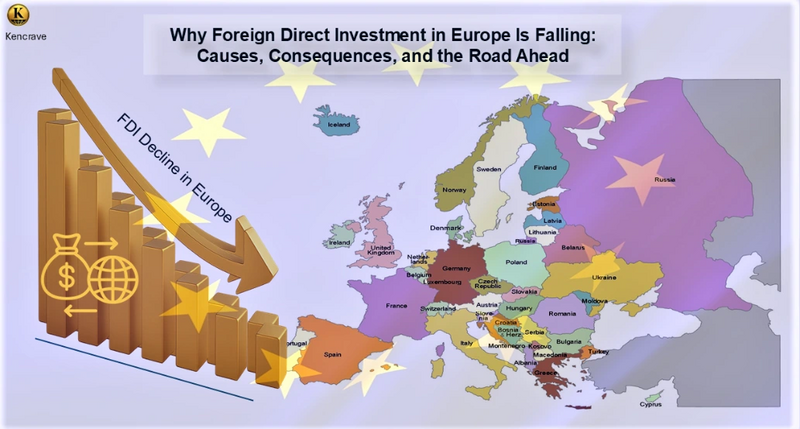
Foreign Direct Investment (FDI) has long been a cornerstone of Europe’s economic growth, job creation, and technological progress. FDI typically involves long-term strategic commitments, such as acquiring at least 10%...