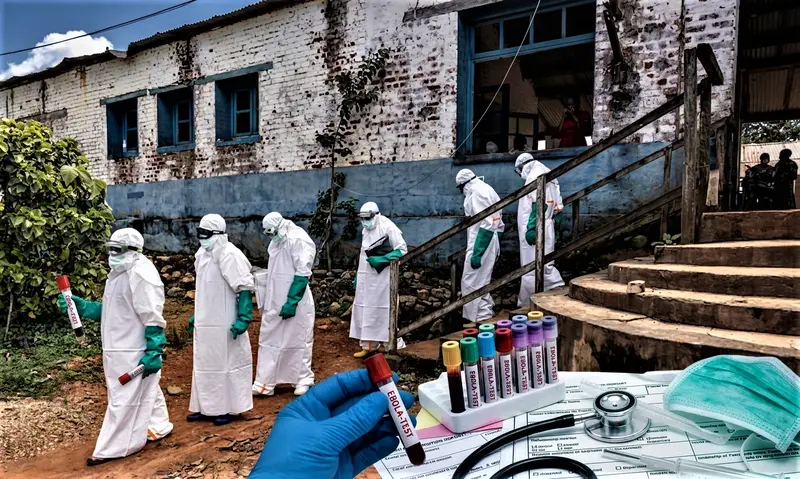
Ebola outbreak response team in protective suits with blood test samples outside medical facility. Image credits: Getty images
Africa
Kenya’s courts have suspended the planned U.S.-backed Ebola quarantine centre in Laikipia County, Kenya. This is after legal objections over transparency, public participation, and concerns about pressure on the country’s health system. The decision has placed Kenya at the centre of a wider debate involving Ebola preparedness, constitutional accountability, and U.S. geopolitical influence in East Africa.
Why Kenya Suspended the U.S.-Backed Ebola Quarantine Centre
Kenya through its courts has suspended the planned U.S.-backed Ebola quarantine centre. The move reflects a clash between the country’s public health concerns, constitutional accountability, and geopolitical pressure.
Kenyan civil society groups, led by Katiba Institute, moved to block the centre through a court petition, arguing that the facility was being established secretly and without public participation. They warned that hosting a quarantine hub for foreign nationals exposed to Ebola could place additional pressure on Kenya’s already stretched health system.
Africa CDC Director Jean Kaseya echoed this concern, noting that taking on international quarantine responsibilities without sufficient support could overwhelm national capacity.
Why the United States Wanted an Ebola Quarantine Centre in Kenya
The United States had pushed for the establishment of the centre as part of its emergency response to a worsening Ebola outbreak in Democratic Republic of the Congo and neighbouring Uganda.
Washington intended the facility to serve American citizens who may have been exposed to the virus while working in affected regions. U.S. officials described it as a state-of-the-art quarantine hub, fully built and operated by American personnel, designed to prevent potentially exposed individuals from returning directly to the United States before undergoing observation.
U.S. officials also emphasized speed. According to senior officials, the centre was expected to become operational within seven days, with a 50-bed capacity ready by the first week of June. The urgency reflected the rapid escalation of the Ebola outbreak in eastern Congo and the need for a secure isolation point outside U.S. borders.
Why Laikipia Air Base Became the Proposed Location
The proposed location of the facility is Laikipia Air Base in Laikipia County, Kenya.
Several reports indicate that U.S. infectious disease experts had already arrived in the country and begun preparations at the site. The base’s strategic position and existing military infrastructure made it a practical choice for rapid deployment and controlled access.
However, the choice of Laikipia Air Base intensified criticism from local leaders and residents, many of whom questioned both the secrecy surrounding the project and the broader implications of hosting such a facility in Kenya.
Public Health and Sovereignty Concerns in Kenya
While the United States viewed the quarantine centre as a necessary safeguard for its citizens, many Kenyans questioned why the country—despite having no confirmed Ebola cases—was selected as the quarantine destination.
For critics, the issue extends beyond health policy. It has raised wider questions about national sovereignty, public accountability, and whether Kenya was being asked to assume disproportionate risk for a project largely designed to serve foreign interests.
U.S. Funding, Ebola Preparedness, and Political Pressure
The proposed quarantine centre also coincided with the U.S. commitment of KSh 1.7 billion (approximately USD 13.5 million) to Kenya to support Ebola preparedness. The funding worth more than KSh 24 billion (inclusive of private funding) has been mobilized to support Ebola preparedness in the region.
While supporters described the funding as part of broader health security and outbreak preparedness efforts, critics argue the financial commitments created political pressure for Kenya to accept a project that primarily served U.S. emergency response interests.
What began as an Ebola preparedness initiative has evolved into a broader debate over governance, sovereignty, and public trust in Kenya. The court’s decision has shifted attention from the quarantine centre itself to the wider question of how international health partnerships are negotiated and approved. The outcome is likely to influence how Kenya engages with future foreign-backed health and security projects beyond the current Ebola response.